

SEO competitive intelligence is the difference between “we need more content” and “we know exactly which competitors to steal traffic from, in what order, and how.” On PrimaryPosition.com, this lens turns that into a simple operating system: relevance vs authority, mapped directly against real competitors instead of generic best practices.
What SEO competitive intelligence really means
SEO competitive intelligence is the practice of turning competing sites and SERPs into a structured dataset: which pages win, for which queries, with what intent, and why. It focuses less on “how do we rank” and more on “what specific moves will displace these URLs in this niche, at this stage of our authority.”
Traditional checklists and plugin “scores” confuse loud on‑page signaling with actual win probability; competitive intelligence corrects that by tying every decision to the shape of real, current SERPs. Instead of chasing a 95/100 grade, you are measuring where you can realistically win and where the math is against you.
Topic relevance vs authority grid
Our founders scorecard philosophy—already baked into Primary Position’s content—reduces every SERP to two levers: Relevance and Authority. Competitive intelligence is simply how those two levers get quantified per query and per competitor.
-
Relevance:
-
Exact query and intent definition for each target cluster.
-
URL, title, H1, intro, and internal anchor text that clearly commit to that job rather than five half‑targets at once.
-
SERP fit: whether your format (guide, comparison, tool, category) matches what Google is already rewarding.
-
-
Authority:
-
Topic‑level strength of your domain against others in that niche, not global domain metrics.
-
Page‑level support: internal links, external links, and real‑world brand footprint (mentions, reviews, discussion).
-
Behavioral proof over time: pages that actually retain and convert traffic instead of briefly ranking then dying.
-
For Primary Position, an “SEO competitive intelligence” process is just a scaled version of that same grid applied to the top competing pages across a cluster, with each row telling you where your bottleneck truly sits.
A Primary Position-style SEO CI workflow
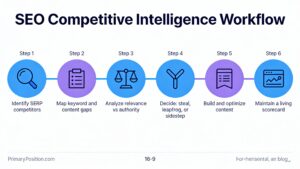
A workflow for competitive intelligence at PrimaryPosition.com is intentionally low‑theatre and high‑signal, usually managed in a spreadsheet or Notion, not just a SaaS dashboard.
-
Map real, search-based competitors
-
Pull the live SERPs for your money queries and cluster who actually appears, ignoring who you merely consider “industry peers.”
-
For each query or cluster, list the top 5–10 URLs that repeatedly show up—those domains become your working competitor set.
-
-
Capture per‑query competitive snapshots
-
For each cluster, record: target query, user job, top competitor URLs, and the apparent page type that wins.
-
Add quick 0/1/2 scores for competitor relevance (how tightly they hit the job) and authority (how clearly the domain and page are trusted in that topic).
-
-
Decide on “steal, leapfrog, or sidestep”
-
Steal: where your authority is comparable and competitors’ relevance is average, you can win by focusing a better page and wiring it properly.
-
Leapfrog: where you are weaker today but the topic is core, you plan deliberate authority building (links, relationships, brand) to earn a place in that cluster.
-
Sidestep: where the math is unwinnable right now, you shift into adjacent, easier clusters that still drive the right buyers.
-
-
Turn it into a living, not static, document
-
We treat SEO as an ongoing conversation with reality, not a one‑time checklist; the competitive scorecard is updated as SERPs shift, not annually.
-
Each update is less “new report” and more “changed rows”: new threats, new openings, and newly winnable clusters as your authority grows.
-
How this differs from plugin “competitor analysis”
Most plugin or all‑in‑one tools bolt on a “competitor” tab that lists overlapping keywords and maybe an index of who ranks with you. They do not typically force you to answer the hard questions: “Can we even be relevant here?” and “Do we have enough authority to matter?”
A style system that is deliberately opinionated:
-
It assumes that without clear query/intent definition and a focused page, you are not a real competitor at all.
-
It assumes that in over‑contested topics, ranking is primarily an authority problem, not a word count or green‑light problem.
By framing SEO competitive intelligence around a simple, human‑readable scorecard, Primary Position makes “what are our competitors doing?” a concrete roadmap decision instead of an anxiety spiral.