
I’ve just got back from Chiang Mai, and I want to get some thoughts down while they’re fresh. Some of this will be uncomfortable for people who’ve built careers around process. That’s fine. I think the way most of us have been doing SEO is about to look very dated.
Notes from Chiang Mai SEO Week
First, a thank you. The Chiang Mai SEO community and the LLM Mastery event were brilliant. The energy in the room was real, and what stood out most was how freely people shared. Nobody was hoarding tactics. People were showing their actual numbers, their actual experiments, and 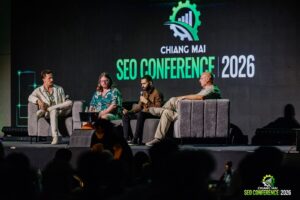 what had and hadn’t worked. And the conversations in between sessions were as valuable as anything on stage.
I’ve also had invitations to Bangkok and Manchester, so if you’re at either, come and say hello.
But the thing I kept coming back to all week was this: we’re at a new dawn for SEO, and most of the industry hasn’t noticed yet.
The SEO bottleneck was never the algorithm
For as long as I’ve been doing this, the biggest thing holding SEOs back hasn’t been Google. It’s been people.
You don’t own the site. You don’t own the content. Somebody else does. And that somebody has their own priorities. Maybe it’s a brand team protecting the look and feel. Maybe it’s a dev team with a backlog stretching into next year. Maybe it’s a stakeholder who wants every page to be perfect before it goes live. Maybe it’s just a competing agenda that has nothing to do with what users are actually searching for.
So the SEO sits in the queue. You write the brief, you wait for sign-off, you wait for the sprint, you wait for the release. By the time your page is live, the opportunity has moved.
AI changes that. Not because it’s magic, but because it removes your dependence on the gatekeepers. If you can build it yourself, you don’t need to wait for permission.
Content without the Committee
I’ve lost count of the hours I’ve watched teams spend polishing content nobody asked for. Five rounds of edits. Legal review. Brand review. A committee deciding whether a heading sounds “on voice.”
Most of that is now irrelevant. You can create landing pages, assets and experiments yourself, quickly, and see what the market does with them. If a page works, you invest in it. If it doesn’t, you’ve lost an afternoon, not a quarter.
The same goes for technical gatekeeping. A lot of “you can’t do that, it needs a developer” just isn’t true anymore.
In SEO, Authority is math, not mood or emotion
While I’m here: can we stop talking about authority like it’s a vibe?
Authority isn’t some fuzzy feeling Google has about your brand. It’s mechanics. It’s the mathematics of how search engines weigh signals, links, relevance and engagement. When you treat it that way, it becomes something you can measure, test and build deliberately, rather than something you hope for.
Vibe coding puts the steering wheel in the SEO’s hands
This is the part that excites me most. With the tools we have now, you can set your own priorities. You decide the schedule. You decide which features ship and when.
Compare that with the usual setup, where a product manager owns the roadmap and the whole thing is driven by perfectionism and internal politics. The user data says one thing, the roadmap says another, and the roadmap wins.
When you can build it yourself, the user data wins. That’s how it should be.
Good SEOs don’t care what the content is
Here’s something that might sound odd: the best SEOs I know are fairly content-agnostic.
They’re not precious about the format or the topic. They chase the data. What’s the user intent? Where are the gaps? What’s ranking, what’s getting clicks, where is the authority, and what actually converts? They follow those signals wherever they go.
The industry, on the other hand, is full of myths. A lot of what gets taught rests on poor foundations. Some of the standard approaches to e-commerce SEO, for example, are built on assumptions nobody has seriously tested. And there’s far too much tribalism. People defend a camp instead of looking at the numbers.
Why I still buy exact-match domains
I’m going to say it: exact-match domains are useful.
Not as some trick to game rankings, but as a testing tool. An EMD, or a related asset, lets you spin up a landing page and find out quickly whether an opportunity is real. You measure it the honest way: through rankings, clicks and authority. If the market responds, you know there’s something there. If it doesn’t, you move on.
Build assets, don’t rent them
This is the bigger point behind the EMD conversation. I want people building and owning digital properties.
Too many businesses rely on one branded domain, or worse, on “rented” visibility on third-party platforms they don’t control. That platform can change its rules tomorrow, and your traffic goes with it.
When you own the domain infrastructure, you get reinforcing advantages. Think of it as a pyramid. Each property you own supports the others, and the whole thing gets stronger as you add to it. The people who own the infrastructure compound. The people who rent it start from scratch every time something changes.
The SEO skills that will matter
So how do you stay ahead? It’s not complicated, but it does take discipline:
- Work with data every day. Get into Google Search Console daily, not monthly.
- Keep doing keyword research. It’s still the foundation of understanding demand.
- Build cornerstone content. The pages that anchor your topics and earn authority over time.
- Experiment constantly. Launch, measure, keep what works, kill what doesn’t.
- Understand how AI search is evolving. Its strategies are still imperfect and changing fast. That’s an opportunity if you’re paying attention.
The people pulling ahead are the ones who control their infrastructure and execute lean.
Stop queueing, start launching
If you’re an SEO, a marketer or a business owner, my message is simple. Stop waiting in the queue. Stop asking permission to test an idea. The bottlenecks that held us back for years are disappearing, and the advantage now goes to whoever ships, measures and learns fastest.
Go build something this week. Then tell me how it went.